Parliamentary elections Hungary: 12 April 2026
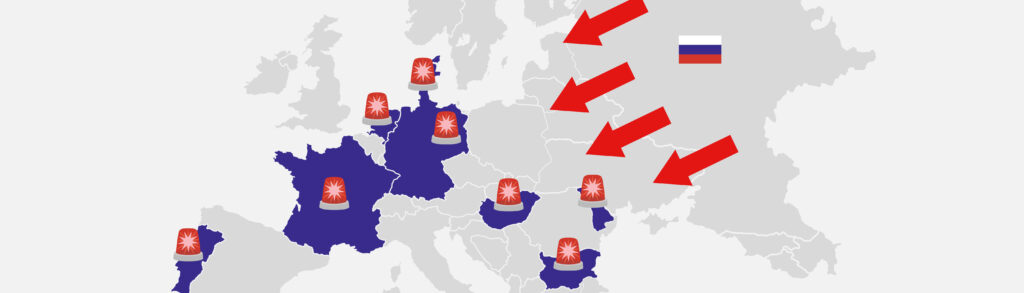
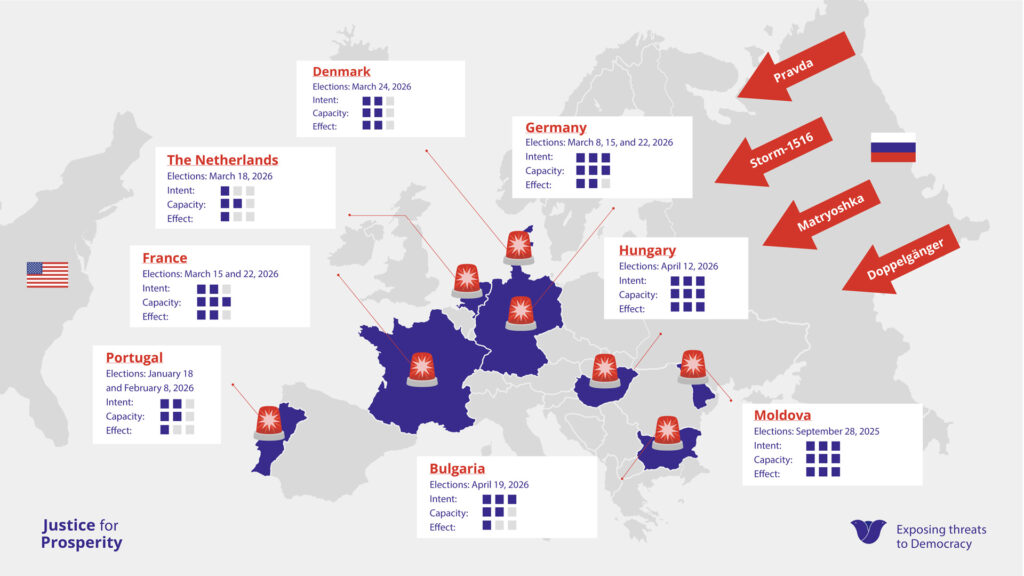
The Justice for Prosperity Foundation (JfP) investigated foreign manipulation and disinformation targeting eight European elections between September 2025 and April 2026. In our report, we mapped the operations, domestic amplifiers and their effect for each country. This page focuses entirely on Hungary.
Hungary is an exception. It seems that Russia is influencing here not only from the outside, but also from within. The goal? To keep Prime Minister Viktor Orbán in power.
We documented a large number of cases.
VSquare revealed, based on multiple European security sources, that three Russian GRU officers have been stationed under diplomatic cover at the Russian embassy in Budapest. The operation is led by Sergei Kiriyenko , Putin’s First Deputy Chief of Staff and the architect of Russia’s political influence infrastructure. This same man orchestrated the interference in the Moldovan elections in 2024.
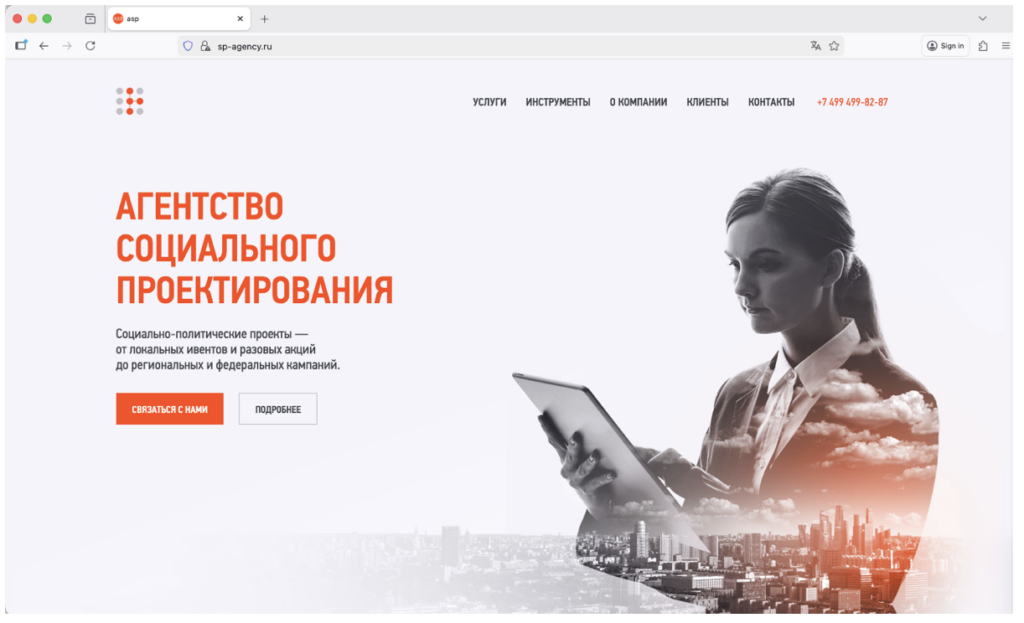
Three days later, the Financial Times reached the same conclusion. The Kremlin ordered the Social Design Agency, an EU-sanctioned Russian disinformation campaign agency, to flood Hungarian social media with Russian-produced content. In it, Orbán is positioned as Trump’s key partner in Europe. The document notes that direct Russian interference could cost Orbán votes. Additionally, the ruling Fidesz party is distributing its own manipulated videos and AI content.
Storm-1516 against Péter Magyar
Three documented Storm-1516 operations target opposition leader Péter Magyar, according to Gnida Project. The pattern is the same in all campaigns: a non-existent investigative organisation, a new domain, a video and allegations of corruption without sources.
- On January 29, 2026, a video appeared from the fictional European Center for Investigative Journalism. The domain ecij.org had been registered nine days earlier. The message: Magyar’s visit to a Ukrainian children’s hospital was a cover for siphoning off 16.7 million euros in EU aid funds.
- On February 4, a second attack followed via timesofukraine.net, registered three days earlier. This time, it was claimed, via a fake website resembling the Ukrainian anti-corruption body SAPO, that Péter Magyar had embezzled forty million euros in EU emergency aid.
- On February 21, a third campaign focused not on Magyar himself but on his ally, Pastor Gábor Iványi. Via oknyomozoriport.hu, registered three days earlier, accusations of pedophilia were spread against the outspoken critic of Orbán.
EDMO, the EU-funded network for digital media research, found that the campaigns were amplified via Facebook ads.

Ukrainian money transport
On March 5, Hungary arrested seven employees of the Ukrainian state bank. They were en route from the Vienna Raiffeisen Bank to Kyiv. The money transport contained 40 million dollars, 35 million euros and nine kilograms of gold. Within a few hours, the pro-Orbán tabloid Ripost.hu published AI-generated footage of the arrest. The post garnered 129,000 comments. Ripost normally scores 10 to 200 comments per post.
Lakmusz ‘s fact-checkers determined that 99 percent of the responses originated from bot accounts with Romanian and Moldovan names. These involved reused fake profiles from the Moldovan election interference of 2025.
Matryoshka Approach
On March 14, 2026, a new FIMI operation was documented that employed the Matryoshka Approach. The FIMI campaign capitalised on the escalating tension between Kyiv and Budapest. Fake videos bearing the logos of Reuters, Euronews and Human Rights Watch circulated online with the false narrative that Zelensky had called Hungarian citizens “idiots,” that a Ukrainian refugee attempted to attack the Hungarian embassy in Paris and that HRW had documented more than a thousand attacks by Ukrainian refugees on Hungarian citizens . None of these events had ever taken place.
On March 24, 2026, Euronews documented another campaign. A fake website spread a fake article claiming that Péter Magyar had called Trump a “senile grandpa” and promised to roll back American agreements. The accompanying video circulated on X with thousands of views. Distributors had nearly identical captions and posted almost simultaneously, indicating coordination.
Influence from within?
Washington Post revealed that the Russian foreign intelligence service SVR was developing an internal plan (codename: “The Gamechanger”) to stage a fake assassination attempt on Orbán. In the same piece, several European security officials stated that Foreign Minister Péter Szijjartó briefed his Russian counterpart Lavrov live during breaks in EU Council meetings regarding confidential discussions and sanctions details. This falls outside the definition of a FIMI operation. However, it does illustrate how inside influence extends beyond disinformation campaigns alone. Several EU officials pressed for clarification. Szijjártó and the Hungarian government rejected the accusations. On 26 March, Politico documented a Russian bot network spreading a narrative about an assassination attempt on Orbán, with Zelensky as the alleged perpetrator.
On 12 April, Tisza, the party of Péter Magyar, won the parliamentary elections by a large majority, ending Viktor Orbán’s sixteen-year rule.
This research covers the period up to and including 30 March 2026. FIMI incidents in the final phase of the campaign are therefore not fully documented.
FIMI operations per country
Click below for more information on election interference in other countries.
Justice for Prosperity (JfP) is an independent research and detection platform based in Amsterdam that exposes and helps counter societal manipulation and subversive threats. We investigate how actors organise themselves online and offline, what networks, narratives, amplifiers and revenue models drive them, and how they put democratic processes and institutions, social cohesion and fundamental rights under pressure.
Support us and donate if democracy is close to your heart. ❤️