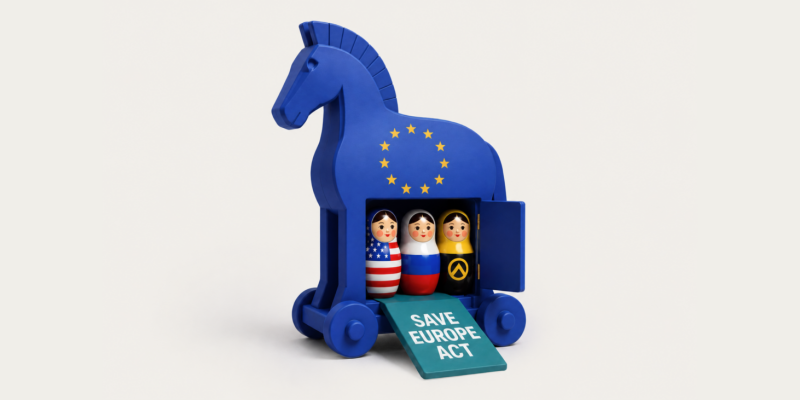
The latest developments regarding IDV have been added at the bottom of the page.
The Justice for Prosperity Foundation monitors networks that create, fuel and instrumentalise social unrest. What we saw in Loosdrecht, Engelen, Ijsselstein and Tilburg over the last few weeks came as no surprise to us. It confirmed what we already saw coming.
Our investigations previously revealed how outside actors were moving into these communities to deliberately stir up localised unrest. However, recent developments highlight a significant international dimension to these activities, proving that the Identitarian movement never truly disappeared but was simply waiting for the strategic moment to reemerge.
The Identitarian Movement is on the rise again - but this time on the backs of genuinely concerned citizens.
Protest is highly valued in the Netherlands and the freedom of speech is part of who we are. That is exactly why it is so disturbing when that voice, the voice of the ordinary citizen, is hijacked by organised extremism. Even more so when this extremism holds international support.
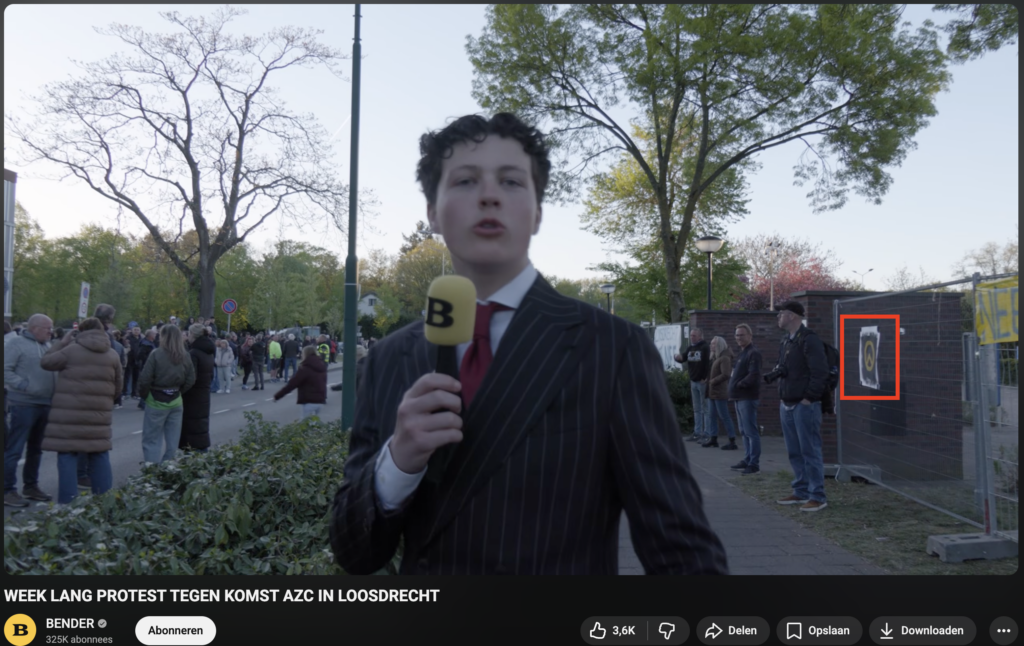
In April 2026, residents of Loosdrecht took to the streets on several evenings to protest against a temporary asylum centre in their former town hall. The atmosphere was grim, riot police were deployed and several evenings escalated into confrontations. The news paints a picture of a local protest. But anyone familiar with how organised actors fuel social unrest recognises something else.
Among the demonstrators, a banner appeared featuring a yellow lambda on a black background. The same symbol surfaced days later in Engelen, then in IJsselstein, and subsequently in Tilburg. The logo belongs to Identitair Verzet, or IDV. The Dutch branch of a pan-European far-right network whose French parent organisation has been banned by the French government as a private militia, whose Austrian leader Martin Sellner received money from the Christchurch terrorist Brenton Tarrant, and whose Dutch founder was convicted for vandalising a Jewish cemetery with swastikas and the slogan “Juden raus” (Jews out).
People standing around that banner in Loosdrecht presumably didn’t know that. Certainly not the concerned local residents. That is exactly why this is signficant.
The Justice for Prosperity Foundation conducts research into societal manipulation. We investigate how actors create, fuel and instrumentalise social unrest, whereby local tensions, genuine concerns and vulnerable groups are deliberately exploited for political or financial gain. We do not take a position in debates. What we investigate is who causes the unrest, who fuels it, how and with what business model.
What is the Identitair Verzet (IDV)?
IDV is the Dutch branch of Generation Identity (GI), a pan-European identitarian movement whose French parent organisation, Génération Identitaire, was banned by the French government in 2021. The Dutch branch had disappeared from view for years. Now it is back.
The movement originated in France in 2003 and operates in multiple countries under a shared ideology and symbolism. It uses the yellow lambda, the letter “L” in Greek. This serves as a reference to the ancient Battle of Thermopylae in 480 BC between the Spartans and Persians.
Their ideological foundation consists of two pillars. The first is the replacement theory, the conspiracy theory that a shadowy elite is deliberately replacing European populations through mass immigration. The second is “remigration,” a euphemistic term for the forced deportation of people based on ethnicity, religion or skin color.
Despite attempts to normalise the word in public debate, a clear line needs to be drawn here. The NCTV is also clear on this: in the language of the far right, remigration means deporting millions of people based on ‘race, religion, sexual orientation or unwelcome views.’
In November 2024, JfP published an extensive study into Génération Identitaire and the way in which the identitarian movement continues to spread its ideology via social media in the Netherlands, Belgium and France. Our conclusion at the time was already that while the movement had disappeared from view, its networks, language and narratives remained very much alive and had further entrenched themselves in the public debate. What we are seeing now is the next step. That report can be read here.
The founder of IDV was convicted in 2001 for his role in the destruction of a Jewish cemetery in Oosterhout. Gravestones were smashed and swastikas were spray-painted. The slogans left behind included “Juden raus” (Jews out) and “Wir sind zurück” (We’re back!). Since then, he has consistently operated under pseudonyms, at least six of which have been documented. Before IDV, he was active with the neo-Nazi party “CP’86” and the far-right extremist organisation Voorpost.
During its active years, IDV protested at mosques in Leiden (2015), Dordrecht (2015), Amsterdam (2017), and Venlo (2017). The organisation ran a front organisation called “Pro Patria,” which organised a demonstration in The Hague’s Schilderswijk in 2014 with a neo-Nazi security force, presented to the public as concerned citizens opposing antisemitism. Several members also participated in international training camps of Génération Identitaire in France, confirmed by then-Minister of Justice Grapperhaus in response to parliamentary questions in 2019. X removed IDV in 2020 for spreading violent extremism.
By 2023, the organisation had virtually disappeared, including their Telegram channel and website. Anyone who did not actively follow the movement might think that IDV was gone forever. But it wasn’t.
The relaunch
Their public return began in recent weeks with a new IDV Facebook launching on March 13, 2026. One of their formerly prominent leaders personally posted the launch flyer: “Here is the kick-off of the campaign!! Please share.” (Translated) Within hours, the post was further disseminated, including by key figures from the anti-asylum groups Defend United and Defend Netherlands.
JfP closely monitored their activities. On April 18, the domain identitair.nl was registered, followed by idverzet.nl three days later. Analysis of the registration data shows that both domains run on an identical German hosting service, using the same registrar and the same outgoing mail server address. This points to one and the same administrator. Thus, the double registration within three days is consistent with a coordinated relaunch.
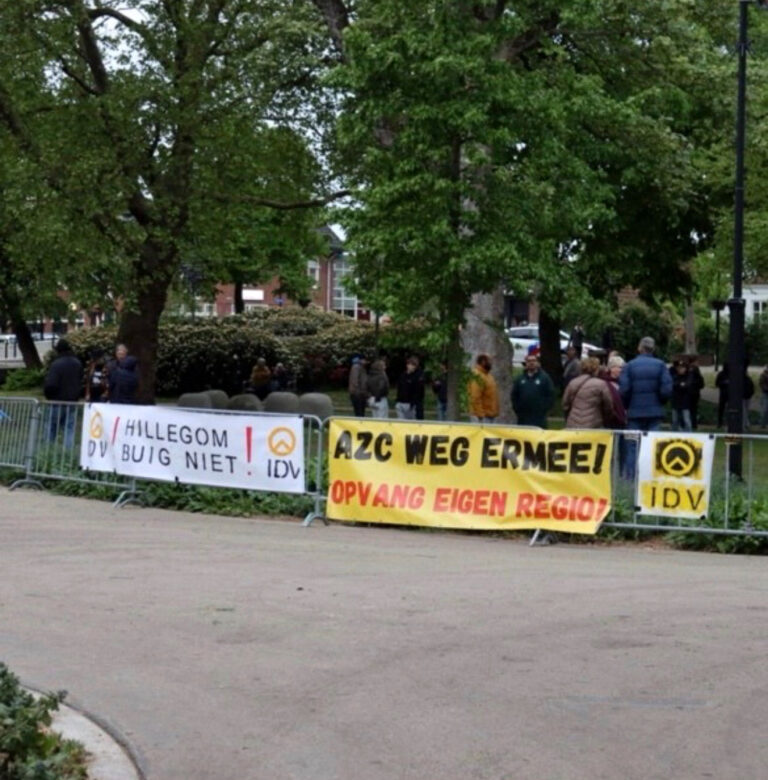
After the online launch, offline promotion got underway via banners and placards.
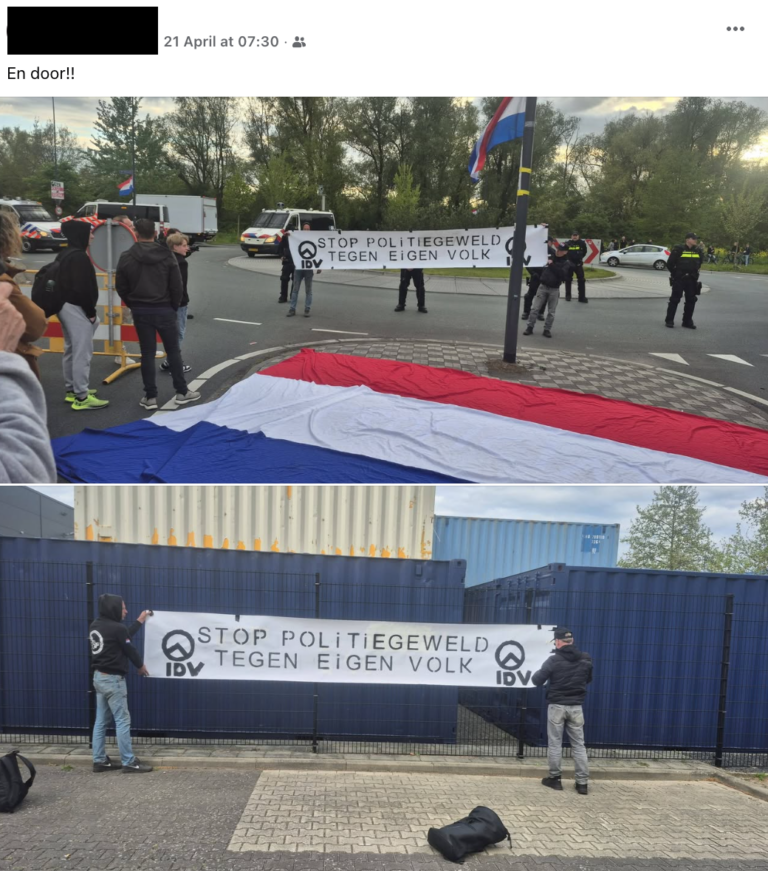
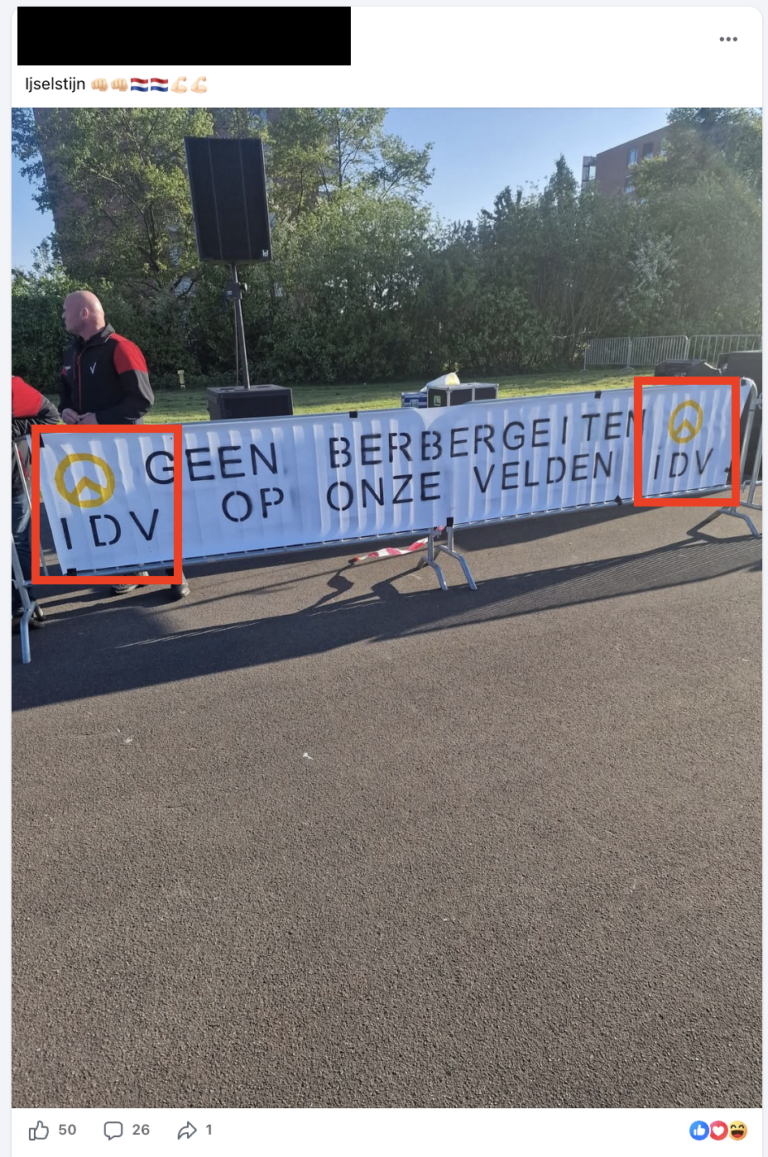
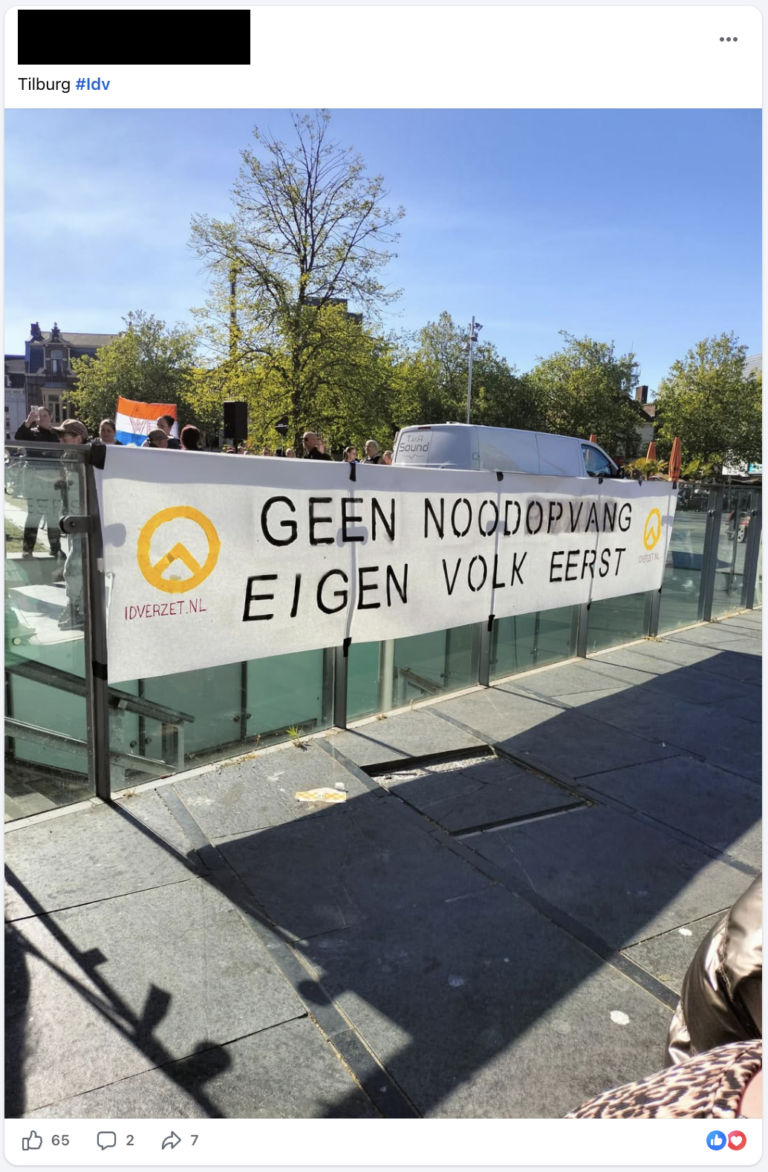
JfP identified the familiar IDV logo. On April 20 in Engelen: “Stop police violence against our own people.” The same banner appeared the next day in Loosdrecht. On April 24 in IJsselstein: “No barbarian goats on our fields.” On April 30 in Tilburg: “No emergency shelter, our own people first,” this time prominently featuring the IDV logo and the website URL. (Translated banner texts from Dutch)
These actions were not spontaneous or sporadic. They were filmed and immediately distributed by Defend members via various private channels. On every occasion, the camera was focused directly on the logo. It is evident that each action was staged for the camera and then promoted via an existing network.
Who is behind it
JfP has definitively identified multiple key figures in the relaunch based on source analysis, network research and field research at the demonstrations themselves. Here, we will describe three of them here based on their public roles and behaviour, not to harm them but because their actions provide insight into how this relaunch operates. We will use initials for all three because our focus is on the phenomenon and the functioning of the network, not on publicly damaging individuals.
F.v.W. is one of the driving forces behind the relaunch. She has a documented history of more than twenty years in the identitarian milieu. This can also be verified in the Kafka research archive and previous media coverage. She personally posted the launch flyer on March 13, hosted the livestream from Loosdrecht, uses the IDV banner as her Facebook cover photo, and responded to criticism regarding her role in the banners with a public claim to ownership. She embodies the revival of IDV.
R.S. operates under a pseudonym and does not wish to appear in the public eye himself. Nevertheless, JfP has been able to identify him with certainty. Not only is his current role striking, but also his path leading up to it. A few years ago, he was active in a local initiative dedicated specifically to connection, tolerance and community. Today, he appears in livestreams of fellow activists wearing IDV symbols and posting openly racist statements. It reveals something the normalisation of far-right ideology – people who once simply moved in conserative leaning spaces are now connecting with a European identitarian network. JfP captured many hundreds of messages of IDV communication covering the period 2018 to 2025 and multiple international figures surfaced: Martin Sellner, the Austrian figurehead of the identitarian movement (see: further in this article), Schild & Vrienden from Belgium, the British far-right group Britain First and Vlaams Belang. Those lines are now being reactivated.
P.v.V. is another key figure within Defend Netherlands. He was present at several banner actions and at the protests in Loosdrecht. He is the operational link between IDV’s identitarian ideology and Defend’s street mobilization network.
Behind these three is a broader support layer of Defend members and related groups. Defend Den Bosch and Women’s Defend Den Bosch actively filmed and distributed the banner actions, with the camera deliberately aimed at the IDV logo. Strijders Nederland shared the banner via its own channels. J.d.B., long active in the identitarian scene, posted photos of the banner in Loosdrecht with the text (all translated from Dutch) “and onwards!!”, liked by Defend Den Bosch leader M.M. and other Defend members. A Defend member responded to the first IDV Facebook post with: “I do have respect for Identitair Verzet, better that they rise up again and grow.” That same member previously posted the code 1488 on his own profile. That is no obscure reference as “14” stands for the “fourteen words,” a neo-Nazi slogan, and 88 stands for “Heil Hitler.”
The international network that IDV connects to
IDV is not a uniquely Dutch phenomenon. It is the Dutch link in a cross-border network of far-right organisations that are banned in multiple European countries and have been directly linked to political violence and terrorism.
France. Génération Identitaire, the French parent organisation, was banned and dissolved by government decree on March 3, 2021. The French state classified the organisation as a private militia inciting hatred and violence. Minister Darmanin called the organisation “the armed wing of extremism and xenophobia.” Dutch IDV members participated in its training camps before the ban.
Austria and Germany. The Austrian branch is under permanent surveillance by the intelligence service. Its leader, Martin Sellner, received a donation of €1,500 from Brenton Tarrant, the Australian terrorist who murdered 51 people in two mosques in Christchurch in March 2019. The two maintained email contact for months. That same Sellner presented the “remigration” plan at the infamous Potsdam meeting in November 2023, which was attended by AfD and CDU representatives, thereby triggering massive protests in Germany. Sellner is subject to an entry ban for the United States, the United Kingdom, and temporarily also Germany. The German branch has been classified as established right-wing extremist by the Bundesverfassungsschutz, the German domestic intelligence agency, since 2019, allowing all available intelligence resources to be deployed to observe the movement.
The term “remigration” appeared in the IDV Telegram archive starting in 2022. Here we can see the ideological line continuing.
The new IDV Facebook page was shared a video by Tommy Robinson, whose real name is Stephen Yaxley-Lennon, one of the most prominent far-right figures in Europe. When footage of the riots in Loosdrecht circulated, Robinson amplified it to his followers by stating that protesters were being beaten down for “peacefully protesting against 110 intruders who were dumped in their community.” This is the same framing as the message on the IDV banner in Loosdrecht: “Stop police violence against our own people.” This is no coincidence. IDV deliberately chose a message that could be widely picked up, even outside the Netherlands. Robinson did exactly what IDV intended, and converted local footage into international reach.
It is not the first time that Robinson and like-minded international influencers such as the Dutch Eva Vlaardingerbroek have spread disinformation about the Netherlands to stoke tensions. JfP previously documented how they deliberately circulated false narratives about the Vondelkerk fire in Amsterdam. That research can be read here.
The new IDV Instagram account exclusively follows other Identitarian movements in Europe. This clearly demonstrates the nodes of an influential network.
How the message works
The banner that appeared in Loosdrecht did not say “send migrants back” or “close the borders.” It said: “Stop police violence against our own people.”
That is a deliberate and well-known choice, positioning the protesters as victims of state terror. It is a message that can be picked up by people who have no affinity whatsoever with the identitarian ideology. And it is designed to be spread across borders – which it was. Robinson’s post used virtually the same wording and framing.
This is how these networks function. The street action generates images and emotion; that material is subsequently picked up by figures with much larger platforms, and local residents coming to the protest do not know that they are standing next to an IDV activist. They think they are standing next to someone with a simple “Defend flag” or a peculiar yellow-and-black logo. But really an extremist ideology is right there next to them, is filming and is using these images as propaganda for a widely branched network that runs from Loosdrecht via Vienna to London.
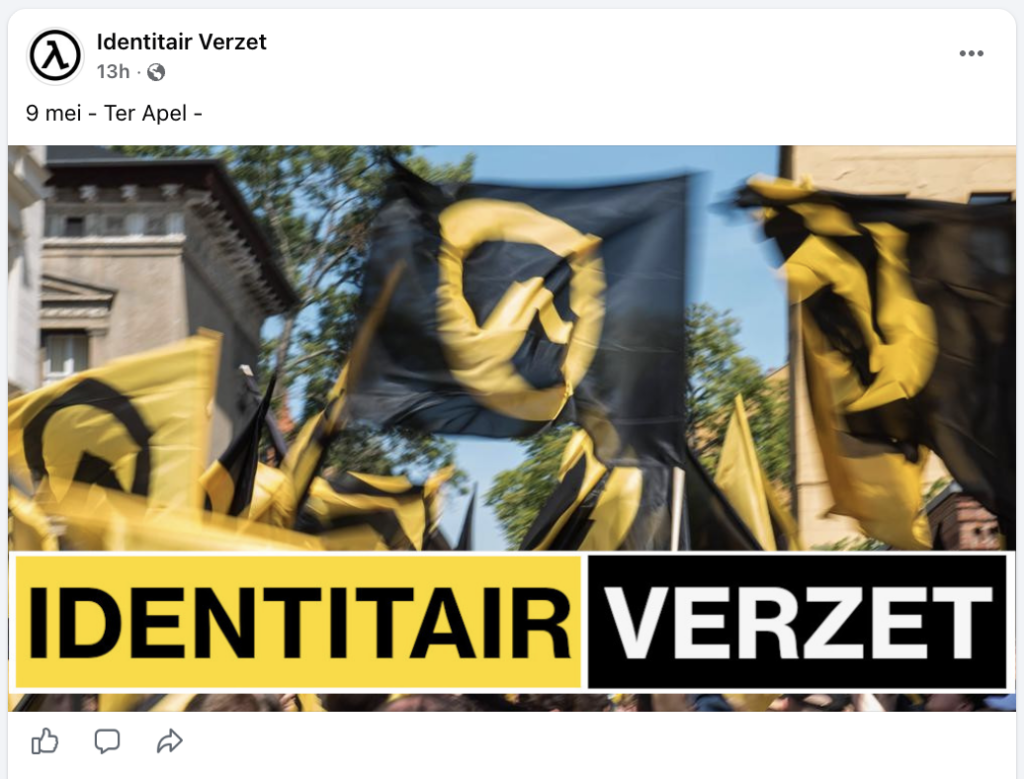
May 9 in Ter Apel
A demonstration has been announced for this coming May 9 in Ter Apel, a location that has long been symbolic in the Dutch asylum debate. For IDV, it is more than that: it is a significant moment when the recently relaunched organization will be publicly present in one place together with Defend groups. It marks a first real test of the collaboration that JfP has been mapping out over the past few weeks. Multiple groups have announced their presence. A counter-demonstration has also been announced.
The combination of organized far-right groups, a counter-mobilization, and the heated atmosphere following weeks of unrest poses a real risk of escalation. Ter Apel therefore calls for both police attention and public vigilance.
Update May 6th:
Identitair Verzet, as well as various Defend groups, have indicated that they will no longer be present in Ter Apel on May 9.
Finally
The relaunch of IDV is a coordinated activation of a known extremist organisation, led by people with decades of experience in far-right activism, during a period of political and social tension surrounding asylum reception.
The people who protested in Loosdrecht are angry about something that is very real to them. While that anger is valid, it is also being instrumentalised. IDV is not present to represent community interests, but instead to nationally integrate an international extremist network at a moment of political tension and to use that moment to normalise, radicalise and recruit.
That normalisation is receiving top-down backing. FvD politician De Vos traveled to Loosdrecht to offer support to the demonstrators, without mentioning who stood between them or prioritising support for the democratic process. When politicians provide cover in this way for violence and protests where extremist organisations are active, it increases the space for the networks described in this article. Local government deserves support while the aggressors don’t. That distinction is a political responsibility.
Intelligence services have been warning the public for years about this mechanism. About how language and messages that once belonged to the most extreme margins migrate to the centre of public debate, thereby lowering the threshold for making contact with the groups that carry them. JfP also described this in detail in the 2024 report on Génération Identitaire. That is what is happening now. IDV does not operate independently of Defend but actually alongside it, and one day are likely to coalesce.
Ordinary citizens who take to the streets out of genuine concern have no idea that they are being deliberately exploited by an international far-right network.
New developments
On Saturday 14 June, R.S., one of the key figures within Identitair Verzet, organised a memorial march through The Hague for Henry Nowak, the British teenager stabbed in early June. During the march, R.S. wore a sweater bearing a Sonnenrad, a symbol rooted in SS mysticism and widely used in neo-Nazi circles. The march ended at the British Embassy. Participants carried white flowers and photographs of Nowak, alongside large black banners reading “White Lives Matter” and “Remigration.” A group of masked men wearing red armbands marched alongside the demonstrators. They served as “stewards”.
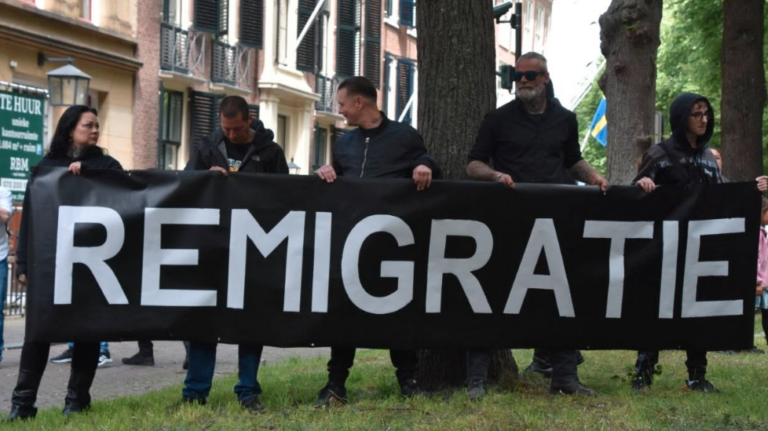
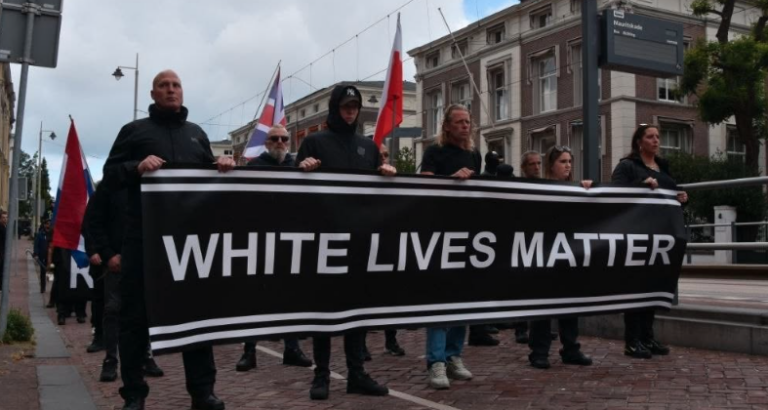
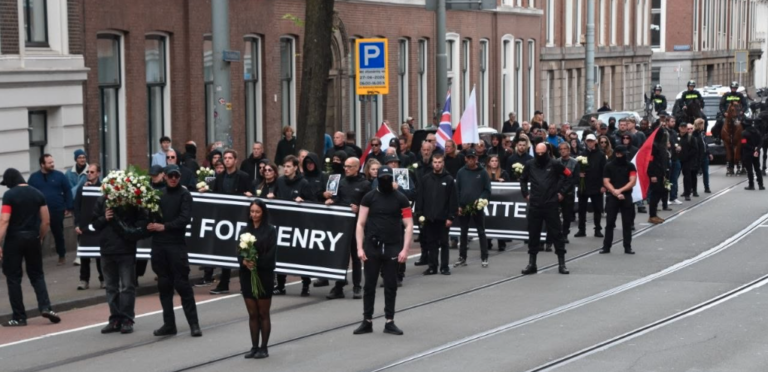
What sets this march apart from earlier actions is the range of groups it brought together. The coalition spanned multiple organisations linked to neo-Nazi ideology. One of IDV’s own channels described the “collaboration with groups from the right-wing flank” as “remarkable.”
The march shows that a key figure within IDV is capable of mobilising a broad coalition of far-right groups that would rarely otherwise appear on the streets together. JfP will continue to monitor the further development of this network.
Support Justice for Prosperity
Reports like this take our team weeks (or months) of research to produce. If you value this work, please consider supporting us with a donation.