And Ongehoord Nederland reinforces the message
The European Union has sanctioned dozens of Russian media channels in recent years. The Russians have found a better alternative. The embassy in The Hague distributes propaganda under diplomatic protection. And Ongehoord Nederland (NPO) turns out to be a major amplifier.
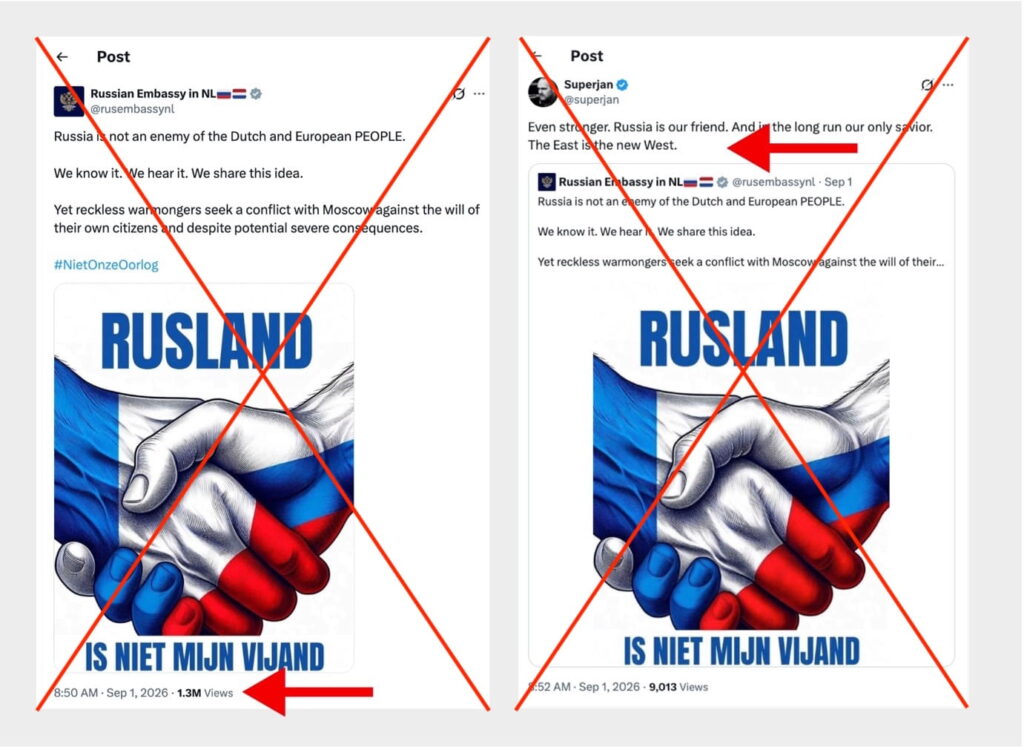
On September 1, the account of the Russian embassy in The Hague posted an image of a handshake in the Dutch-Russian flag colors. The message: ‘Russia is not my enemy’. Below this followed a text about ‘reckless warmongers’ who allegedly sought a conflict with Moscow against the will of their own population. It concluded with a Dutch hashtag: #NietOnzeOorlog (NotOurWar). The post has since garnered 1.3 million views. The account itself received approximately 20 million views in ten months. Over the past few months, Jan Bennink, podcast maker at Ongehoord Nederland (NPO) amplified the Russian embassy’s propaganda more than 50 times.
While Kyiv is under fire day after day, with air raid sirens sometimes lasting as long as half a day, Russia’s hybrid war also continues unabated. Investigative platform Justice for Prosperity (JfP) analyzed 200 messages from the embassy over the past ten months. About 40% of the messages follow the pattern of coordinated information manipulation by a foreign state. The European External Action Service (EEAS) refers to this as FIMI for short.
In addition, approximately 45% of the total number of messages focuses directly on domestic affairs, ranging from government policy and government officials to media and civil society organizations. In doing so, the embassy pits the Dutch government directly against its own citizens. Article 41 of the Vienna Convention on Diplomatic Relations obliges diplomats not to interfere in the domestic affairs of the host state.
The embassy's account serves primarily as a propaganda channel.
The European Union has sanctioned dozens of media outlets (such as RT, Sputnik, and Voice of Europe) in recent years. The embassy account publishes under its own name and under diplomatic protection, reaching the Dutch public directly. This creates a particularly effective propaganda channel. This is not a Doppelgänger or Pravda website, or an anonymous Telegram channel, but an official embassy account with diplomatic protection and a checkmark that X uses to mark government accounts.
The messages in practice
‘Moscow will not ignore aggressive statements by Dutch officials’, ‘Dutch pilots in Ukraine, if any, are a legitimate target’, ‘there is no limitation period for war crimes in Russia’ (to Nieuwsuur), ‘Consequences and retaliatory measures will be tough’ (regarding the frozen Russian assets), and ‘reckless warmongers seek a conflict with Moscow against the will of their own citizens’. We see demands on government officials, intimidation, threats of retaliation, and attempts to set up a government against its citizens. The message containing the demand on the Dutch government was viewed over 2.6 million times. Regarding the will of the citizens over 1.1 million times. The statement about Dutch pilots over 227,000 times.
The Russian embassy is familiar with the treaty, according to a message on 16 april 2025:

Mirror and amplifyer
The messages from the embassy fit what JfP previously referred to as ‘disinformation disparity’. This can be read in our report ‘The Russian disinformation war against Europe’, an analysis of influence campaigns during eight elections in Europe.
The Kremlin systematically monitors which domestic actors spread polarizing or disruptive messages. These messages are picked up and amplified and sent back into the information ecosystem. The aim is to fuel polarization, destabilize and disrupt democracy from within. Russia rarely invents the narratives used itself. The country often rides on existing sentiment, for example an (attempted) disruption due to fear. Likewise, the hashtag #NotOurWar does not come from Moscow.
Domestic amplifiers
For successful disruption, Russia relies on ‘domestic amplifiers’. These are local media, opinion leaders, and politicians who share Russian narratives with their own constituencies. Jan Bennink, the podcast maker for Ongehoord Nederland (NPO), frequently shares messages from the embassy. His two accounts (@superjan and @Rumpelstunzchen) have a combined total of over 70,000 followers. Over the past few months, Bennink has amplified messages from the Russian embassy more than 50 times. In the message on September 1 (see image), Bennink wrote that Russia is ‘our friend’ and, in the long run, ‘our only savior’. The embassy account also responds to Bennink regularly, revealing clear interaction.
Bennink himself recently stated that he is not simply a contrarian opinion maker, but acts as a mouthpiece for the Russian embassy on Dutch public broadcasting episode 43 from June ‘26 of the NPO podcast Bergsma & Bennink. ‘I follow the Russian embassy’s account very closely’, ‘Very good tweets’, ‘otherwise I think they are very nice people’. His podcast colleague Bergsma adds: ‘Yes, but inform them too’. And Bennink: ‘Russians are actually never caught in a lie’.
Criticism of the war or of arms deliveries to Ukraine may well be a legitimate political stance. But criticism is different from amplifying the messages of a Russian state propaganda channel. Actors such as Bennink, who systematically adopt these narratives, function as ‘local amplifiers’ and thereby directly serve the goals of the Kremlin.
This is how Kremlin influence works
On September 2 in Bishkek, Kyrgyzstan, Putin was asked a question about the German accusation that Russia was behind the failed drone attack near Leipzig. His answer soon moved away from the drone. He linked the accusation to Germany’s domestic problems. He spoke about falsified evidence, the German economy, confidence in Merz, and the elections. The first are in Saxony-Anhalt, where the AfD stands at around 40% in the polls.
This tactic is also clearly visible in the communication of the Russian embassy. A foreign conflict is reduced to domestic political relations and policy. Clear societal manipulation by sowing doubt about governments, media, and democratic institutions.
A question to politicians in The Hague
The Russian embassy targets Dutch voters, politicians, and media directly, and exacerbates societal divisions. This is also the case in the run-up to the Provincial Council elections in March 2027. It happens daily from Russia and their troll factories in West Africa, but now also from The Hague. Just around the corner. Where do we draw the line? Has the Vienna Convention been violated by this? Will the ambassador be held accountable for this?
To the NPO and Ongehoord Nederland
Bennink is free to think what he wants. However, Bergsma & Bennink is a production of Ongehoord Nederland on NPO Luister. The Code of Conduct for Journalistic Practice applies to it, to which ON! commits itself in its own editorial charter. Opinions are allowed, but claims must be verified. In 2022, regarding Ongehoord Nieuws, the Ombudsman ruled that this also applies to opinion programs. Does the editorial board of Ongehoord Nederland stand behind this? And what is the NPO doing with a production on its own channel that transmits propaganda from a Russian state channel?
Support Justice for Prosperity
It takes our team weeks (or months) of research to compile these types of reports. If you appreciate this work, please consider supporting us with a donation.