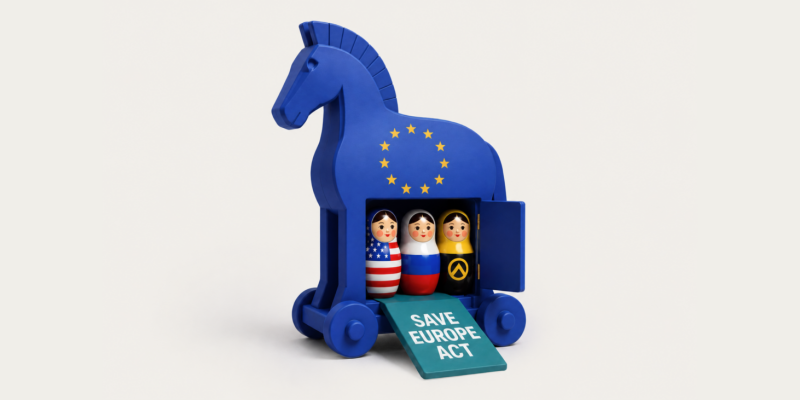
Every day, thousands of people are exposed to online messages that look like news but are posted solely to generate anger and hatred. They originate from coordinated networks of pages posing as news, sports, or showbiz and are largely controlled from abroad. Hatred and polarisation have become a business model. This fuels unrest and undermines our democracy. The Dutch case is a node in this international network.
The Justice for Prosperity (JfP) Foundation analysed 353,913 responses to 15,526 Facebook posts across an international network of 251 pages, distributed across 15 larger groups. The picture is unambiguous: messages inciting hatred and anger are generated 24/7 purely to make money from advertisements. The hatred is primarily directed at groups such as migrants and asylum seekers, and individuals like politicians. This type of content does not disappear into a vacuum. It fuels an online environment in which anger and distrust are stoked daily, driven by money.
Most posts contain the call to action “read more in the comments,” after which the reader is redirected via a link to a website with advertisements. The more anger a post evokes, the more visitors go to the website and the more is earned. This is measurable. The most polarising posts attract approximately three times as many responses as neutral posts. For neutral posts, 1 per cent of the responses receive an angry emoji. For polarising posts, this rises to 39 per cent. Both the necessary text and images are generated by AI. The content is easy to replicate and costs remain low. The same mechanism runs simultaneously in multiple countries and languages.

In a one-week sample, JfP found 83,737 angry emoji reactions on the 251 selected pages where fabricated content about foreigners and politicians is used to generate traction. When we extrapolate this to a year, that amounts to well over 4 million. And that anger almost always points in the same direction. For right-framed posts, 78 per cent of the reactions are in agreement and only 4 per cent are critical. With the sporadic left-wing posts, it is the other way around: they receive support in 15 per cent of cases.
Of the pages whose management location we were able to determine, 85 per cent are located wholly or partially abroad, primarily in Vietnam, followed by the United States, Ecuador, Armenia, and Sweden. However, countries in Africa and Asia also appeared. The hundreds of pages turn out to be in the hands of a small number of administrators, who direct their traffic to approximately seventy domains. Only some of these pages are administered locally by nationals.
JfP is now mapping this phenomenon on a large scale for the first time and showing how the mechanism works, whereas earlier publications by Nieuwscheckers, for example, described individual components of it. That mechanism strikes at the heart of the democratic debate. Anyone following these pages gets a distorted picture of what is going on in their countries and can be influenced as a result. Behind that image now lies not an ideology, but a business model in which fuelling polarisation yields more than nuance.
Support Justice for Prosperity
Reports like this take our team weeks (or months) of research to produce. If you value this work, please consider supporting us with a donation.