In the run-up to the Dutch municipal elections, Russian disinformation found a new path to Dutch-speaking audiences. The investigative Justice for Prosperity Foundation has traced how a fabricated news story, first deployed during the German state elections, reached Dutch-speaking readers just 24 hours later – and racked up millions of views in a matter of days. The case reveals how foreign disinformation travels across Europe through established networks and local amplifiers, and how rapidly it can take hold as elections approach.
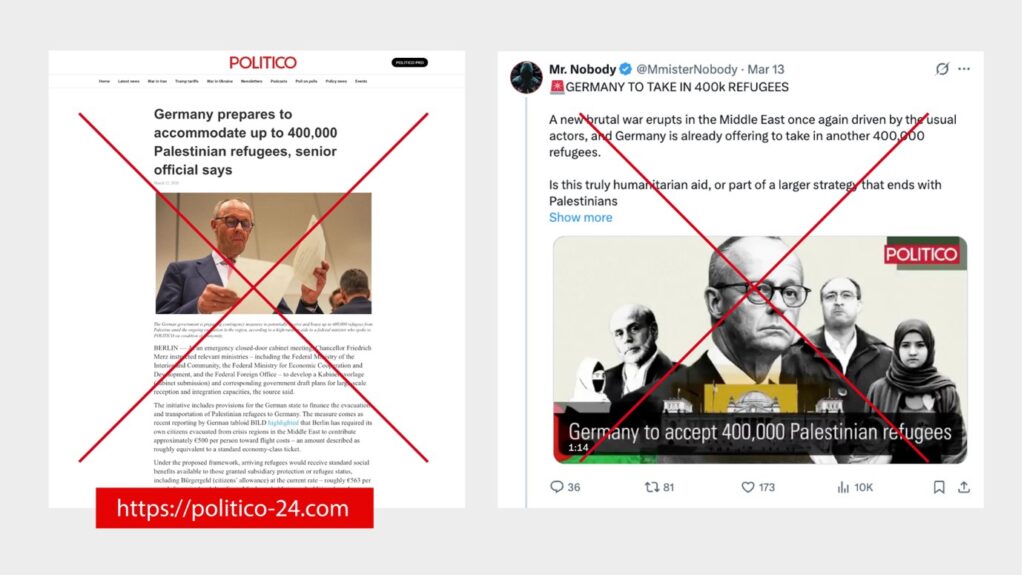
The story broke first in Germany, not the Netherlands. On 12 March, as voters headed to the polls in the German state elections, a completely fabricated video surfaced in Politico’s visual style, carrying the false claim that Chancellor Merz had decided to take in 400,000 Palestinian refugees. The video bears the hallmarks of Storm-1516, a Russian disinformation operation that French intelligence agency VIGINUM links to military intelligence service GRU, Russia’s military intelligence service. A fake website, politico-24.com, was built to support the deception, mimicking Politico’s real site before going offline. A spokesperson for Axel Springer, Politico’s publisher, confirmed to news agency DPA that the site was a forgery.
Within 24 hours, the story had crossed into Dutch-speaking territory. On 13 March, the Dutch website dissident.one picked it up, and it quickly spread through Telegram channels including De Bataafse Leeuw, Gek Genoeg and Onafhankelijke Pers Nederland. On X, a single post garnered more than three million views and nearly 500 retweets. Storm-1516 built the content and the infrastructure. Dutch and Belgian users carried it the rest of the way. One of them even wrote “Politico says so too.”
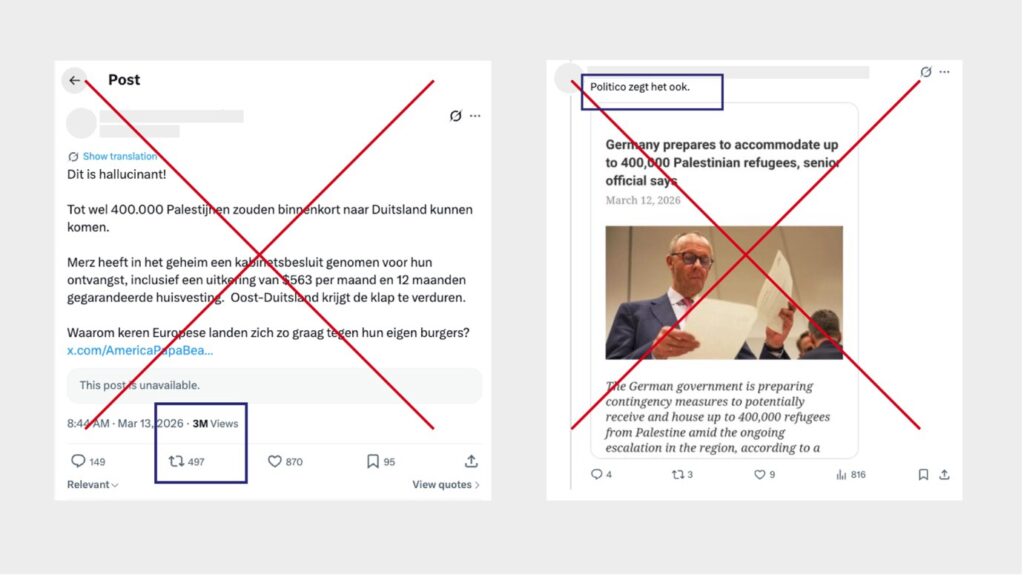
What launches in one country can flow rapidly through existing networks to the next, gaining credibility along the way.
This is not an isolated incident
Justice for Prosperity examined Russian disinformation operations targeting elections in eight European countries between September 2025 and April 2026. The pattern was consistent across nearly all of them: the same infrastructure, the same playbook, retooled each time for local audiences and national contexts. This case is not an outlier. It is part of a coordinated operation spanning a wide European front.
A previous version of this report has been updated based on new findings and kind suggestions.