On 18 March, the Netherlands heads to the polls for the 2026 municipal elections. Local democracy is close to home. It’s your neighbourhood, your municipality, your vote. But what if the political ads appearing on your Facebook or Instagram feed have no legal right to be there? And what if the platform serving them knows full well that these ads are not allowed and does nothing about it?
The Justice for Prosperity foundation (JfP) did not only investigate illegal political ads. We also mapped their total reach.
European Political Advertising Regulation
Our investigation was prompted by the European Political Advertising Regulation (PAR), a law requiring online political ads to be transparent: who is paying for them, and who is being targeted? The reasoning is simple but fundamental. When political parties try to influence you, you have the right to know how, and by whom.
Major tech companies including Meta and Google decided these transparency obligations were too burdensome and chose instead to ban political advertising on their platforms across the European Union entirely. Enforcing that ban is their responsibility.
How Big Tech bent the law to its will
Rather than making their advertising systems transparent as the legislation requires, platforms like Meta and Google opted for a different way out. They wrote in their own terms of service that political ads are simply prohibited on their EU platforms. No political advertising means no transparency obligations. Problem solved, or so it seemed.
Appearances, however, are deceiving.
Meta's enforcement falls short
JfP’s investigation shows that Meta consistently fails to enforce its self-imposed ban. Working with the University of Amsterdam and researcher Fabio Votta, JfP identified hundreds of ads that should never have appeared online under Meta’s own rules: political ads, visible to anyone, placed on pages that Meta’s own platform registers as belonging to political parties.
That last detail is crucial. Meta already possesses the information it would need to identify and block these ads. JfP’s data shows that more than half of all the ads in question come from pages that have categorised themselves as a “political party.” The technical barrier to acting is therefore extremely low. Yet nothing happens. This does not seem like a question of inability. It seems like a question of unwillingness. Meta has a direct financial interest in keeping these ads online, because that is what it gets paid for.
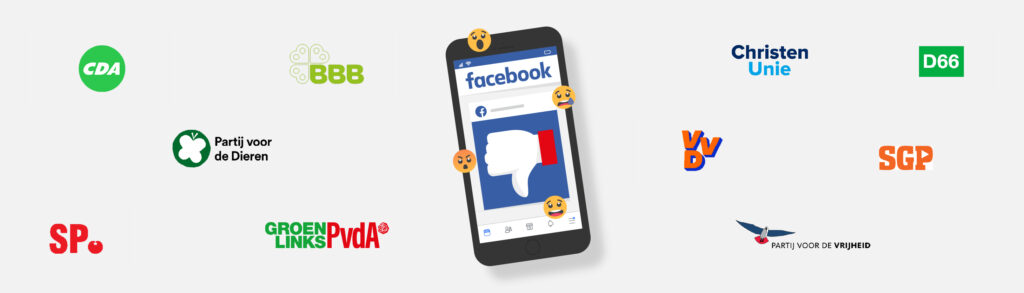
Of the 517 ads JfP identified, only 80 have been removed. That is just 15% of the total. The remaining 85% are still live, giving an unfair advantage to the parties that placed them. The vast majority of these – 88% – come from local parties. The remaining 12% comes primarily from local branches of national parties. JfP identified 72 unique advertisers in total. Local branches of GroenLinks-PvdA together placed the most illegal ads on Meta, followed by CDA, D66, SP, SGP, ChristenUnie, VVD, FvD, BBB and PVV.
These parties bear their own responsibility. But Meta is ultimately accountable for what political advertising appears on Instagram and Facebook. The Dutch Data Protection Authority has since sent warning letters to around 40 political parties over these ads.
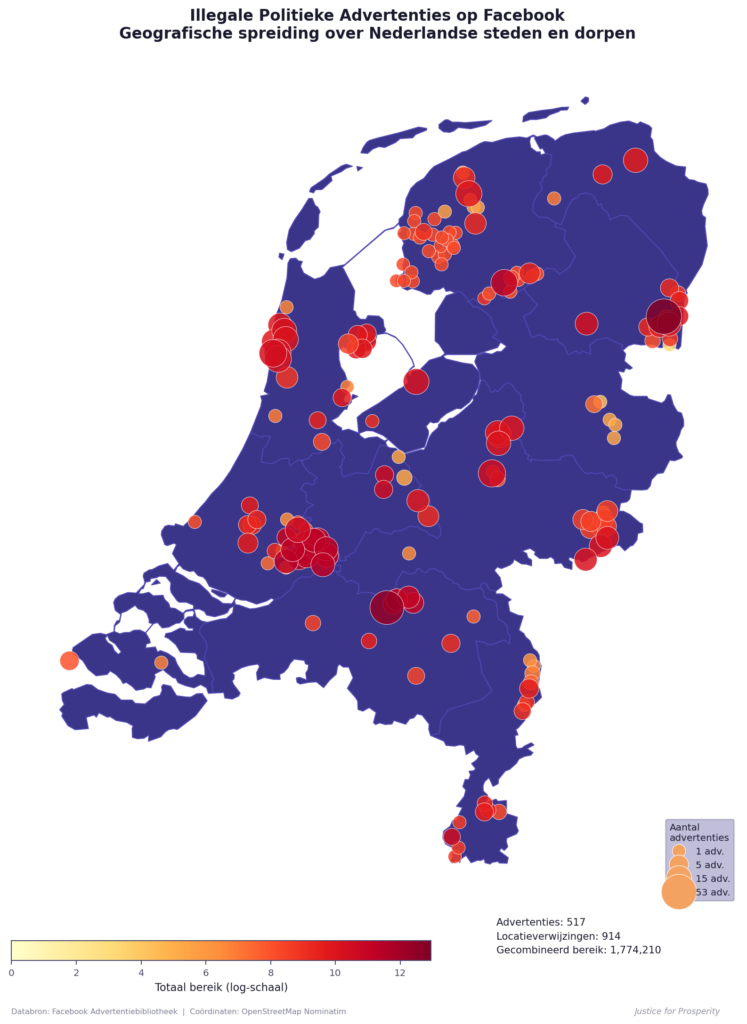
Rule-breaking at scale
Having identified the ads, JfP went a step further and mapped their reach. The 517 ads have a combined total reach of 1,774,210 (and counting). In practical terms, this means you have seen, or may yet see, illegal political ads on Facebook or Instagram. You now also know that this is, to put it mildly, not acceptable behaviour from those placing them. This kind of unlawful influence has no place in a healthy democracy.
An uneven playing field
Parties that do comply with the rules are paying a price for it. Those who stay within the law have fewer options than those who break it without consequence. This creates an uneven playing field ahead of the 2026 municipal elections, and an uneven playing field is a direct threat to fair democratic competition.
Meta's response
When Nieuwsuur (Dutch television) put questions to Meta about the illegal ads, the company stated that ads on social issues, elections and politics violate its EU policy. A spokesperson said protecting election integrity was a priority and that action had already been taken against a number of offending ads.
It may sound reassuring, but JfP continued to find illegal political ads after that statement was made. With just 15% of ads removed, their “priorities” have not been fully upheld.
Our recommendations
JfP is calling on Meta to enforce its own rules consistently. The data needed to identify political ads from registered party accounts already exists within Meta’s systems. Since more than half of the channels in our dataset are registered as political party pages, automated enforcement is technically feasible and could be implemented quickly.
We also look to the role of Dutch regulators. Both the Dutch Data Protection Authority (AP) and the Media Authority have a role in overseeing compliance with the PAR. In the week before the municipal elections, the AP already sent warning letters to around 40 political parties and previously informed political parties through a 27-page guidance document. The question is whether local parties and branches (many of which have no data protection officer) have actually read and understood that guidance. It is also worth asking whether all these violations genuinely stem from ignorance. It is not inconceivable that some have simply weighed the risks and decided the benefits of advertising outweigh them.
JfP is calling for clarity on advertising across Meta, TikTok and Google: “Political ads must not be permitted on platforms such as Facebook, Instagram, YouTube and TikTok for as long as those platforms cannot guarantee compliance with the PAR’s transparency requirements”.
The distinction between education and enforcement matters. Formal enforcement of this European legislation falls to Irish regulators, since Meta is headquartered in Ireland. Current developments suggest those regulators are either not doing this effectively or cannot handle the workload.
Our recommendation to national political parties is straightforward: contact all local and regional teams and remind them, again, if necessary, that political advertising is not permitted on Meta or Google.
The technical step towards consistent enforcement by Meta is a small one. JfP will continue to monitor developments in the run-up to 18 March 2026. “The foundation for well-informed voters lies in a transparent media landscape. One shaped, to a significant degree, by the choices platforms like Meta make every day.”
The Justice for Prosperity foundation is an independent investigative platform focused on mapping social manipulation and influence. Here you will find our report on interference during the Dutch municipal elections of 18 March 2026.