Tate at #2 on Substack’s “rising” rankings
Andrew Tate was banned from the major platforms that helped make him. Now he is gaming his way back.
You might know him as the misogynist or the extremist. Or as the man who helped turn the manosphere into a recruitment machine, reaching millions of young men worldwide before being banned from major platforms.
Then came criminal charges in Romania, including on human trafficking and rape, as well as legal troubles in the United Kingdom.
Now he appears to be attempting a comeback, with Substack as one front in that effort.
For the Justice for Prosperity Foundation (JfP), this is a story about how actors who profit from misogyny, grievance, and polarisation adapt to platform pressure, rebuild audiences, and search for new ways back into the information space.
JfP detects and disrupts actors who undermine democracies. The pattern matters more than the scale. This is one of those moments.
How platform manipulation works
Substack highlights “rising” stars: newsletters that are growing quickly in subscriber count. Appearing there brings organic visibility. It can drive new readers through the platform, trigger algorithmic recommendations, and confer a kind of credibility as a relevant voice within a category.
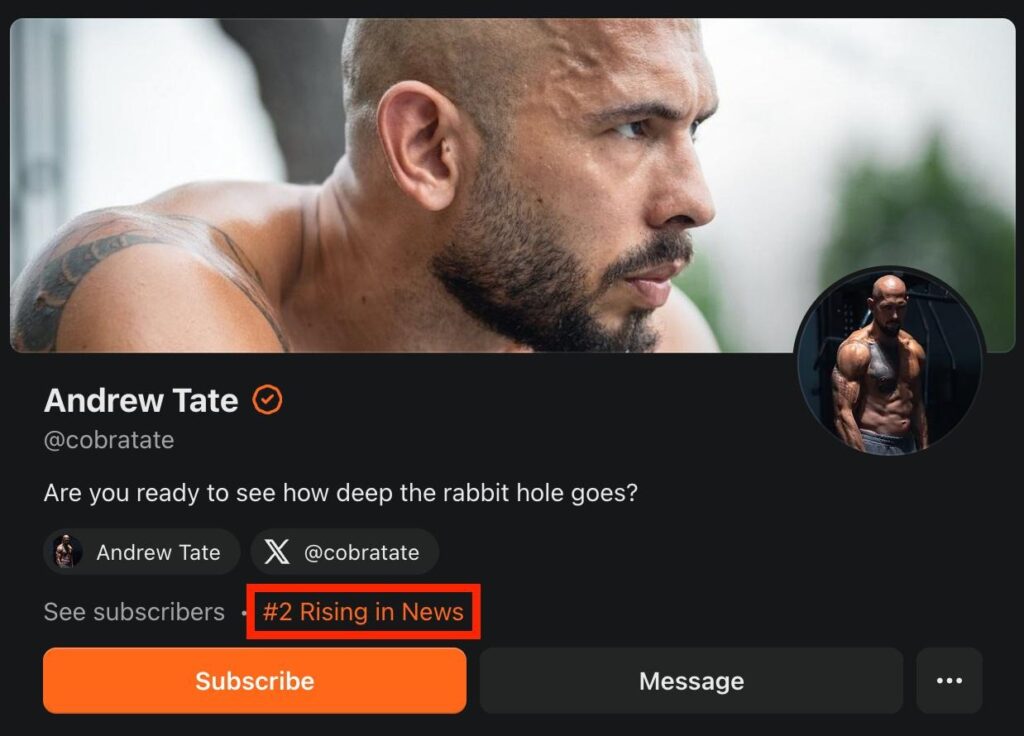
At the time of our investigation, Tate ranked second among the fastest-growing newsletters in the News category. That meant thousands of Substack users were shown his name as a recommended rising voice. The algorithm elevated him based on apparent growth velocity.
What created that apparent velocity is where the story becomes interesting.
A sudden appearance
Archive.org provides a useful baseline. The Internet Archive first captured Tate’s Substack account on 14 April 2026. Comparable accounts on the platform show archive histories stretching back years. The absence of earlier snapshots suggests Tate’s account did not exist on the platform before mid-April 2026.
Yet when the archive first captured it on 14 April, the account already showed 1.1 million subscribers.
That number did not accumulate gradually on Substack. It was imported. The posts on the account appear backdated to create the impression of a longer publishing history.
Between late March and mid-April 2026, we monitored subscriber account creation patterns among Tate’s Substack followers. Substack does not provide full follower lists publicly; our data represent a sample returned during scraping, yielding 951 unique accounts rather than the full 1.1 million. That sample, however, showed a distinct temporal cluster.
The sharpest concentration appeared between 20 March and 20 April 2026. On 12 April alone, nine accounts in our sample had been created that day. By mid-April, half of all sampled accounts had been created within the preceding sixteen days.
The absolute numbers reflect sampling limitations. What stands out is the temporal pattern: a sharp, sustained spike in account creation dates concentrated in a narrow window immediately preceding the account’s public appearance on Archive.org.
Signs of coordination
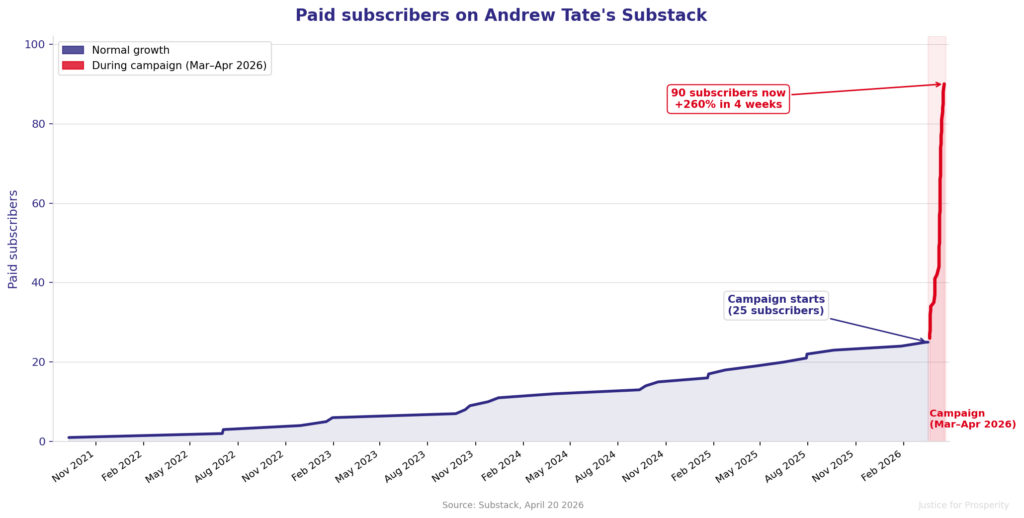
The pattern suggests subscriber growth driven by newly created accounts rather than established Substack users choosing to follow Tate organically. The timing is unusually precise: account creation begins on 20 March and accelerates day by day, culminating in the 14 April archive snapshot showing 1.1 million total subscribers.
More striking still, 75% of the sampled April accounts have no bio, no publications, and no visible activity elsewhere on Substack. Their only observable function is to subscribe to Tate’s newsletters.
Even accounting for the limitations of a partial sample, this temporal clustering of bare, newly created accounts aligns with patterns associated with coordinated inauthentic behaviour. The concentration differs markedly from the gradual, distributed account creation patterns observed among subscribers to comparable Substack accounts.
Why Substack
Tate is on Substack for a reason. The platform has for years been criticised for its tolerance of far-right figures.
In November 2023, The Atlantic reported that at least sixteen Substack newsletters featured Nazi symbols in their logos or cover images, while many more were actively spreading far-right views. More than two hundred Substack authors later signed an open letter saying it was incomprehensible that people promoting ideas such as the “Great Replacement” could use the platform to attract subscribers and generate income.
Substack co-founder Hamish McKenzie initially refused to act. Only in January 2024 did the platform remove five accounts, and even then without announcing any broader policy change. Far-right figures, including Alt-Right founder Richard Spencer, have continued to operate on Substack.
Tate fits that environment. On Substack, he publishes and promotes misogynistic and far-right content that faces restrictions elsewhere. The subscriber increase we documented appears designed to help that space grow.
Why this matters. And what comes next.
What we are documenting appears consistent with a coordinated effort to influence the platform algorithm. That technique is scalable: whoever can do this on a small scale can do it on a larger one. And if it works here, it is likely to be used elsewhere.
The pattern is clear. Tate is working to re-establish himself as a relevant voice by manufacturing the appearance of relevance until it starts producing real reach. Algorithmic credibility today. Real audience growth tomorrow. A platform from which to serve misogynistic and polarising content to audiences that, without this manipulation, might never have found him.
This is what the Justice for Prosperity Foundation is here for. To detect early. To expose before it scales. To help ensure that parents, children, authorities, and the wider public are not caught off guard. Because by the time the numbers do start to look impressive, more people may already have fallen into these traps.
So, when Tate starts appearing in trending lists, rising rankings, and recommended newsletters, that visibility may be manufactured rather than earned through genuine audience interest.
By that point, he may already have rebuilt a vast audience, with renewed room for his polarising narratives to grow.
That is exactly why JfP has reported its findings to Substack and will continue to monitor the situation closely.
Support Justice for Prosperity
Reports like this take our team weeks (or months) of research to produce. If you value this work, please consider supporting us with a donation.