
Far-right Defend groups are expanding quickly and travelling across the Netherlands to influence local decision-making, particularly concerning asylum seeker centres (AZCs). Their actions are coordinated, and undermine democracy.
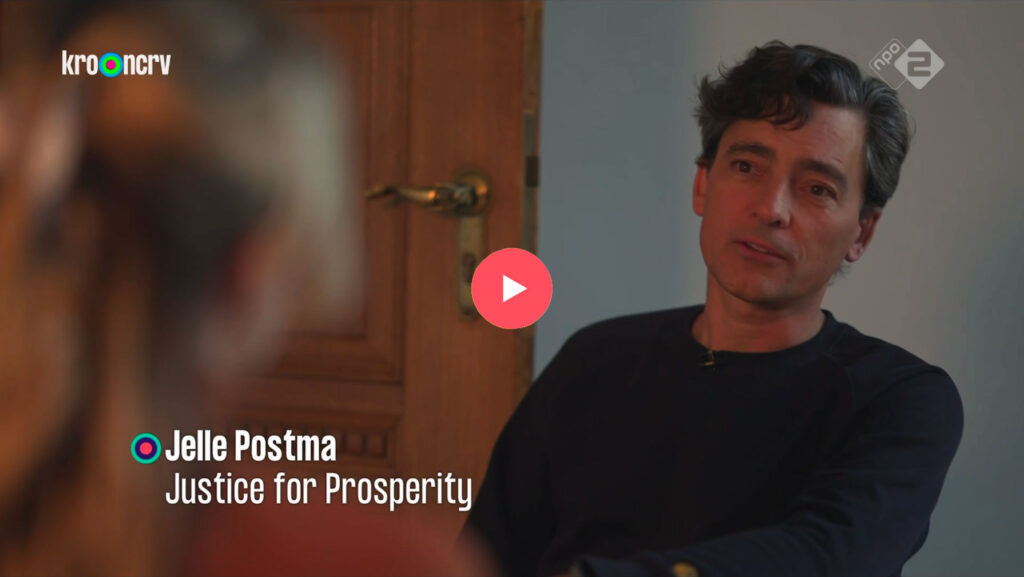
Research by the Justice for Prosperity Foundation (JfP) and Pointer (KRO-NCRV) shows they are part of a deliberate strategy to exert pressure on political and administrative processes at the local level. A voice message from an administrator of the Defend Netherlands Telegram group confirms this. The same investigation uncovered far-right, racist content and veiled calls for violence within the movement.
Who are these groups?
The Defend movement operates under two umbrella organisations: Defend United and Defend Netherlands. Defend United grew out of Defend Den Bosch and now has multiple local chapters. JfP and Pointer examined the movement’s communications, internal dynamics and structure, finding that the network expanded rapidly in a short space of time. The investigation has thus far identified 35 distinct components.
Defend Netherlands differs. The group appears to have been founded in the summer of 2025, roughly seven weeks before the riots on the Malieveld last year. Our investigation also found that prominent figures within Defend Netherlands have prior run-ins with the police and justice system. One was arrested for wearing an NSDAP shirt; another was convicted of incitement during a protest.
Both groups frequently operate in tandem. Key figures from Defend Netherlands and Defend United regularly appear at the same demonstrations and interact with each other’s posts online. Multiple sources also confirm the two groups maintain close contact.
Local influence as a deliberate strategy
JfP and Pointer established that Defend members attended at least 21 local demonstrations against asylum seeker centres or migration more broadly. Recent examples include protests in Nieuw-Lekkerland, Bleskensgraaf and Houten. Voice recordings make clear this is not coincidental:
“If you stand at a small demo outside a town hall, where the decision-making actually happens, you have far more impact on whether an asylum centre comes or not.”
This voice message was sent by an administrator of the Defend Netherlands Telegram group on 25 November 2025. It spells out precisely how Defend wants to operate: turn up at local demonstrations where the decisions are actually made. A handful of people making noise outside a small town hall carries far more weight than a crowd lost on an empty Malieveld.
Extremist content and (veiled) calls for violence
The movement presents itself publicly as peaceful, but internal communications tell a different story. JfP and Pointer found openly racist and antisemitic messages from active members and key figures. Asylum seekers are compared to monkeys. Jews are dismissed as unwanted. Muslims are described as ”het kanker van de wereld” (the cancer of the world). One person who regularly operates alongside Defend publicly describes himself as “NSBer 2.0” (the “NSB” or National Socialist Movement was a Dutch Nazi Party) and poses in photographs wearing a beanie bearing the number 88, a well known neo-Nazi symbol. The movement only intervenes when Nazi ideology becomes too visibly public.
Veiled calls for violence
In Telegram conversations, anonymous members openly conclude that violence works. A key figure within Defend Netherlands questions on Facebook whether peaceful protest serves any purpose at all. But it goes even further than this. Members call for opponents to be eliminated and suggest going “on the hunt.” One member’s profile reads: “Violence is the last resort for the people and the fatherland.”
The threat of violence turns concrete when Defend key figure “P.v.V.” posts on Facebook that he has tracked down a home address, promising to knock the teeth out of the resident, someone with left-wing views. Several Defend groups also shared this post. Earlier remarks by P.v.V. are just as disturbing: “Where violence is used, asylum centres don’t go ahead.” Anonymous members in the Telegram group echo the sentiment: “I notice that almost everywhere a demo gets out of hand, no asylum centre has been built.” The response: “Exactly, intimidation simply works. You don’t think we throw fireworks out of mischief, do you? A few bangers in the council chamber and those cowardly [antisemitic slur] eat out of your hand.”
Growing sophistication
The Defend movement’s tactics are becoming increasingly sophisticated. Members have begun exercising their right to address council meetings, taking their campaign inside the town hall while demonstrators gather outside to apply additional pressure. In November 2025, Defend Netherlands put out a call for “stars who want to address councils together with us.”
One key figure has spoken at council meetings in Uitgeest and Lisse, among other places, being very open in his threats. In Uitgeest, he pointed out that municipalities where unrest had occurred had subsequently changed their policy, and that those who want to avoid unrest should better listen up. In Lisse, the same figure demanded a referendum, closing with: “Time will tell which side of history you stood on.” This is a barely veiled reference to the “tribunals” called for by, among others, FvD member Pepijn van Houwelingen and former Speaker of the House Bosma (PVV).
The public addresses were matched by violence outside. In Uitgeest, the council meeting had to be suspended after a fireworks bomb was deployed outside the building. In Lisse, police were forced to clear the area around the town hall.
Conclusion
New Defend groups are emerging quickly. What began in 2025 with a handful of groups has grown to 35, identified by Justice for Prosperity and Pointer. Publicly, these groups present themselves as respectful and law-abiding. A closer look reveals something else entirely.
The movement combines far-right ideology with a concrete aim: to influence local decision-making around asylum seeker centres, and to do so through means that undermine democratic processes. Groups travel across the country to organise, attend or disrupt local demonstrations. Behind a public façade, internal communications and conduct reveal a movement in which extremist views, intimidation, and support for violence (veiled or otherwise) are all part of the picture.
JfP has published this report because threats and violence have no place in a democracy, and because local administrators deserve broad support in carrying out their work. The problem extends beyond its impact on decision-making alone: it risks deterring people from entering local politics or standing as candidates. Many administrators have so far shown considerable resilience in the face of this pressure, and we urge them to report criminal offences to the police. The Justice for Prosperity Foundation will continue to monitor developments and report on what is developing behind the scenes.
Disclaimer: We apply the AIVD’s definition of right-wing extremism and have identified the Defend groups accordingly.